Readable challenge card
The child can understand the first mission from one card, with a simple objective, visual cue, and optional extension for older builders.
The lab turns building play into visible experiments. Children can see a gear move, a remote action change direction, a balance decision affect speed, and a character story become a testable challenge. Every metric and checklist is written for smart toys, construction learning, and safe electronic play.
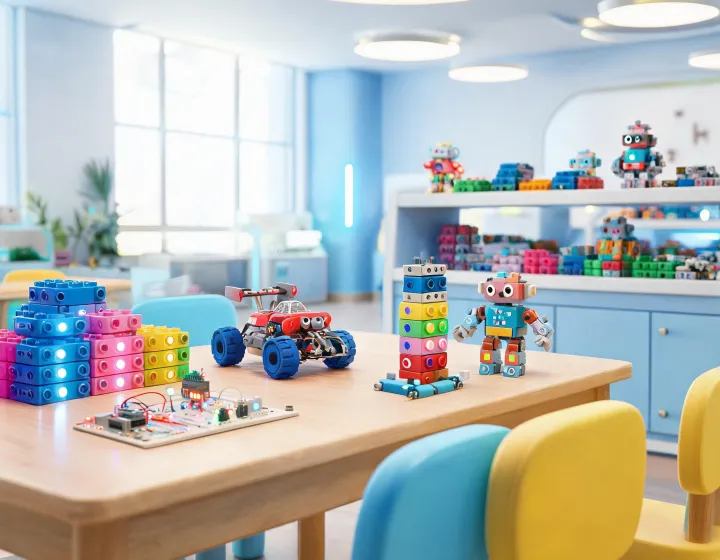
Every experimental kit is reviewed through the same practical lens: can a child understand the cause, can an adult explain the boundary, and can the toy invite a better second attempt? The table gives buyers a concise view of how smart play is evaluated before launch.
| Lab metric | What we measure | Why it matters for kids |
|---|---|---|
| Build-to-action time | Minutes from opening a kit to seeing a model move or respond | Shorter first feedback keeps curiosity high before detailed engineering begins. |
| Rebuild loop depth | Number of meaningful changes a child can test without new parts | Repeat experiments teach iteration instead of treating the first model as final. |
| Control clarity | How easily children connect a button, wheel, sensor, or remote input to an outcome | Visible cause and effect turns electronic play into a STEM conversation. |
| Safety boundary | Age grading, battery access, speed profile, and small-part guidance | Families can say yes to more advanced play when the limits are plain. |
The child can understand the first mission from one card, with a simple objective, visual cue, and optional extension for older builders.
Gears, wheels, ramps, balance points, or motion paths are easy to observe, so the lesson is not hidden inside a sealed plastic shell.
Pieces, batteries, remotes, and instruction cards return to a tidy state quickly enough for repeated family or classroom use.
A beginner can finish the base model, while a more confident child can modify speed, shape, symmetry, role-play scene, or test condition.
Battery access, charging notes, speed limits, and supervised-use language are written before photography, packaging, or retail copy begins.
The experiment still has an imaginative reason to exist, whether the build is a rescue rover, a racing bot, a lightsaber display, or a moving stage prop.
We will review the play loop, safety boundary, and STEM signal, then return a concise concept path for building blocks, role-play worlds, or RC and electric extensions.
Request a Lab Review